9 Best Spin Down Sediment Filters for Whole House Use (November 2026)
The best whole house spin down sediment filters include the iSpring WSP-50 Spin Down Sediment Filter for routine prefiltration, the Waterdrop RPFK Spin Down Sediment Filter for varied plumbing, and the iSpring WSP-50SL Spin Down Sediment Filter for scale prevention.
On this page (8 sections)
- How to choose a spin down sediment filter
- Compare spin down sediment filters by screen and flush method
- Which spin down sediment filter suits your home?
- How do screen size and sediment level affect the choice?
- How should you set up and care for a spin down filter?
- Is a spin down filter enough for well water?
- What mistakes should you avoid when buying a spin down filter?
- Which spin down sediment filter should you choose?
The iSpring WSP-50 is the best starting spin down sediment filter for routine whole-house prefiltration, with a reusable screen, clear housing and flush valve. If your water carries heavy sediment, choose a coarser screen or a larger chamber; if you want cleaning on a schedule, consider an automatic-flush model.
A spin down filter catches particles such as sand, rust and grit before they reach finer treatment equipment. It is a first stage for physical sediment, so pair it with a separate filter or softener when your water test points to other treatment needs.
If you're planning a full treatment setup, compare the options in our whole house water filters for well water guide. For scale concerns, our water softener and water filter guide explains why a sediment screen and a softener do different jobs.
Our picks at a glance
-
1
 Best for routine prefiltration
iSpring WSP-50 Spin Down Sediment Filter
8.9/10 our score
See it on Amazon -
2

-
3
 Best for scale prevention
iSpring WSP-50SL Spin Down Sediment Filter
8.3/10 our score
See it on Amazon
- 4
 Check it
iSpring WSP50ARB Big Spin Down Sediment Filter
Best for scheduled cleaning - 5
 Check it
iSpring WSP-100 Spin Down Sediment Filter
Best for coarser filtration - 6
 Check it
Waterdrop RPFK15 Spin Down Sediment Filter
Best for screen flexibility - 7
 Check it
Waterdrop BG103 Mega Spin Down Sediment Filter
Best for muddy well water - 8
 Check it
iSpring WSP100ARB Auto-Flushing Spin Down Filter
Best for automatic coarse screening - 9
 Check it
Rusco 1-1/2-60-F Spin-Down Filter
Best for large PVC lines
How to choose a spin down sediment filter
Choose by matching the screen to your sediment, the fittings to your pipe, and the flushing method to the maintenance you will actually do. A good fit also needs enough space, a suitable pressure range and the right indoor or outdoor conditions.
Start with the particles you need to catch. A 50-micron screen catches smaller particles than a 100-micron screen, while options such as 200 or 500 micron suit coarser debris.
A finer screen can clog faster when water carries a lot of sediment, so the smallest number is not automatically the best choice.
Next, check your plumbing connection. These picks use combinations of MNPT, FNPT, push-fit, SharkBite or PVC fittings, and those labels are not interchangeable.
Identify the pipe material and size, then confirm the filter's fittings or adapters before you plan the installation.
Think about cleaning before you buy. A manual flush valve is simple, but you need to inspect the housing and open the valve when sediment collects.
Automatic flushing reduces routine attention, though it adds controls, a power requirement and more installation considerations.
Also check the operating limits and available clearance. Some models are for indoor use only, and larger housings need room for the body, valve operation and a drain hose or outlet.
If the filter will sit before a softener or finer filter, confirm that the planned flow and connections work for the full system.
Compare spin down sediment filters by screen and flush method
These spin down sediment filter picks range from compact manual-flush units to larger models with multiple mesh options or automatic controls. Use the screen and connection details to narrow the list, then consider how much sediment the filter must handle.
| Product | Best for | Screen | Connections | Use | Our score |
|---|---|---|---|---|---|
| iSpring WSP-50 Spin Down Sediment Filter | routine prefiltration | 50 micron | 1 in MNPT and 3/4 in FNPT | Indoor; 40–100 F, 15–115 psi | 8.9 |
| Waterdrop RPFK Spin Down Sediment Filter | varied plumbing | 50 micron | 1 in MNPT, 3/4 in MNPT, 3/4 in FNPT and 3/4 in push-fit | 8.6 | |
| iSpring WSP-50SL Spin Down Sediment Filter | scale prevention | 50 micron | 1 in MNPT and 3/4 in FNPT | Indoor; 40–100 F, 20–100 psi | 8.3 |
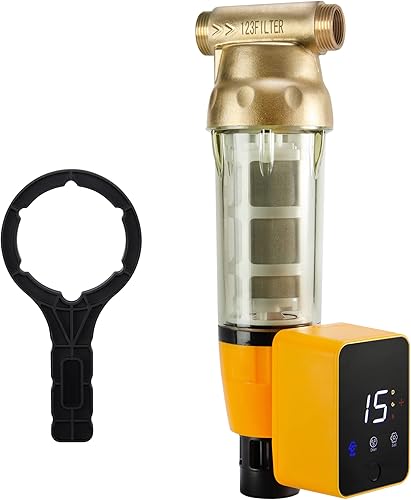
| iSpring WSP50ARB Big Spin Down Sediment Filter | scheduled cleaning | 50 micron | 8.2 | ||
| iSpring WSP-100 Spin Down Sediment Filter | coarser filtration | 100 micron | 1 in MNPT and 3/4 in FNPT | Indoor; 40–100 F, 15–115 psi | 8.1 |
| Waterdrop RPFK15 Spin Down Sediment Filter | screen flexibility | 8.0 | |||
| Waterdrop BG103 Mega Spin Down Sediment Filter | muddy well water | 7.8 | |||
| iSpring WSP100ARB Auto-Flushing Spin Down Filter | automatic coarse screening | 100 micron | 1 in MNPT and 3/4 in FNPT | 7.7 | |
| Rusco 1-1/2-60-F Spin-Down Filter | large PVC lines | 60 mesh | 7.0 |
Which spin down sediment filter suits your home?
The iSpring WSP-50 is the strongest all-around pick for routine prefiltration because it combines a reusable 50-micron screen with a clear housing and simple flushing. The other models suit specific needs such as varied fittings, coarse debris or scheduled cleaning.
iSpring WSP-50 Spin Down Sediment Filter: Best for routine prefiltration
- 50-micron stainless steel mesh
- Flushable and reusable
- Clear housing
- 1 in MNPT and 3/4 in FNPT connections
A reusable 50-micron screen and clear housing make this a straightforward prefilter when you can flush it as needed. iSpring specifies indoor use.
Pros
- Flushable reusable screen
- Clear housing for visual checks
- Brass head and stainless steel mesh
Cons
- 50-micron screens may clog quickly in high-sediment water
- Indoor use only
The WSP-50 is a practical starting point if you want a reusable screen before a finer filter or water softener. Its clear housing makes sediment visible, so you can check the screen and flush it as needed.
The brass head has 1-inch MNPT and 3/4-inch FNPT threads on both ends. A garden hose barb fitting is on the flush-out valve, which can make routine flushing more convenient when you have a place to direct the water.
iSpring specifies indoor use at 40–100 F and 15–115 psi. The brand warns that its 50-micron screen may clog quickly in high-sediment water, so skip this compact option if your source water is consistently muddy or gritty.
Choose it for a straightforward first stage and visual checks. If you need more treatment after sediment removal, compare the larger options in our Big Blue filter housing guide.
Waterdrop RPFK Spin Down Sediment Filter: Best for varied plumbing
- 50-micron 316L stainless steel mesh
- Manual backwash
- 20 gpm maximum flow rate
- Four connection fitting types
The RPFK combines a 50-micron screen with manual backwash and several connection options. Its stated maximum flow rate is 20 gpm.
Pros
- Multiple connection fitting types
- Manual backwash function
- NSF/ANSI 372 certified and lead-free
Cons
- 50-micron screen may need frequent attention in high-sediment water
- Not for a 3/4 in garden hose
The Waterdrop RPFK is a good choice when your plumbing needs more fitting options. It includes 1-inch MNPT, 3/4-inch MNPT, 3/4-inch FNPT and 3/4-inch push-fit connections.
Its 50-micron 316L stainless steel screen cleans through a backwash function, and the stated maximum flow rate is 20 gpm. Waterdrop gives an operating pressure range of 14.5–72 psi and says the filter is NSF/ANSI 372 certified and lead-free.
Choose it when the fittings match your pipes and manual backwash suits your routine. Skip it if you need a 3/4-inch garden hose connection, because this model is not designed for that use.
iSpring WSP-50SL Spin Down Sediment Filter: Best for scale prevention
- 50-micron screen
- Flushable and reusable
- Siliphos included
- 1 in MNPT and 3/4 in FNPT connections
This version adds Siliphos to a flushable 50-micron prefilter. iSpring says the Siliphos helps prevent scale and corrosion.
Pros
- Flushable reusable screen
- Siliphos feature
- Clear housing
Cons
- iSpring recommends replacing the filter every 3–6 months
- Indoor use only
The WSP-50SL suits buyers who want a sediment screen with an added Siliphos feature. iSpring says Siliphos helps prevent scale and corrosion, while the screen itself catches physical particles.
This model has a clear housing and the same 1-inch MNPT and 3/4-inch FNPT connection types as the WSP-50. It is intended for indoor use at 40–100 F and 20–100 psi, and iSpring recommends replacing the filter every 3–6 months to prevent scale buildup.
Choose it if the Siliphos feature fits your setup and you can follow its replacement schedule. Don't choose it as a substitute for a conventional softener when hardness reduction is your goal; see our whole-house water softener system guide.
iSpring WSP50ARB Big Spin Down Sediment Filter: Best for scheduled cleaning
- 50-micron stainless steel mesh
- Auto, semi-auto and manual flush modes
- Built-in scraper
- 1 in MNPT and 3/4 in FNPT connections
The WSP50ARB adds a touch-screen flushing module and scraper to a 50-micron screen. It suits buyers who want automatic, semi-automatic and manual flush options.
Pros
- Several flush modes
- Built-in scraper
- Works with copper, PEX and CPVC pipes
Cons
- Needs a power source for the auto-flushing module
- Confirm connections and installation space
The WSP50ARB is for households that want flushing controls instead of relying only on manual reminders. Its touch screen offers automatic, semi-automatic and manual modes, while a built-in scraper helps clean the screen during flushing.
The 50-micron stainless steel mesh sits in a unit with a brass head and transparent housing. Its stated maximum flow rate is 25 gpm, and it connects with 1-inch MNPT and 3/4-inch FNPT fittings.
Choose it if you prefer to set a flushing schedule and have a power source at the installation point. Skip it if you want the simplest possible valve-and-screen setup or lack room for the control module.
iSpring WSP-100 Spin Down Sediment Filter: Best for coarser filtration
- 100-micron stainless steel mesh
- Flushable and reusable
- Clear housing
- 1 in MNPT and 3/4 in FNPT connections
The 100-micron screen offers a coarser option than the 50-micron picks. iSpring notes that screens may clog quickly when sediment levels are high.
Pros
- Flushable reusable screen
- Clear housing for visual checks
- Brass head and stainless steel mesh
Cons
- A coarser screen lets more small particles pass
- Indoor use only
The WSP-100 is a better fit when you want a coarser screen than the 50-micron models. Its 100-micron stainless steel mesh is flushable and reusable, with a clear housing for checking sediment buildup.
The unit has a brass head and 1-inch MNPT and 3/4-inch FNPT connections. iSpring specifies indoor use at 40–100 F and 15–115 psi, and warns that a 100-micron screen may still clog quickly if sediment levels are high.
Choose it when a coarser screen better matches your water and you can inspect it regularly. It is not a good match if your goal is to catch finer particles before a sensitive downstream filter.
Waterdrop RPFK15 Spin Down Sediment Filter: Best for screen flexibility
- 100-micron and 500-micron mesh options
- 20 gpm maximum flow rate
- Reverse-flush cleaning
- 1 in MNPT, 3/4 in FNPT, 3/4 in MNPT and SharkBite fitting
The RPFK15 includes 100-micron and 500-micron mesh options and a reverse-flush valve. Its specified maximum flow rate is 20 gpm.
Pros
- Two mesh options
- Reverse-flush cleaning
- Multiple connection types
Cons
- Install above 4 C and avoid outdoor installation
- Confirm which mesh fits your water
The Waterdrop RPFK15 is for buyers who want two mesh options and reverse-flush cleaning. It includes 100-micron and 500-micron meshes, so you can select a coarser or finer screen to suit the incoming water.
It has a stated maximum flow rate of 20 gpm and an operating pressure range of 14.5–72 psi. The fitting set includes 1-inch MNPT, 3/4-inch FNPT, 3/4-inch MNPT and a 3/4-inch SharkBite fitting.
Waterdrop says to install this model above 4 C and avoid outdoor installation. Choose it if its temperature limits and fitting set work for your location; skip it for an exposed outdoor installation.
Waterdrop BG103 Mega Spin Down Sediment Filter: Best for muddy well water
- 500-micron and 200-micron mesh filters
- 25 gpm maximum flow rate
- Manual forward and reverse flush
- 20 times larger chamber claim from Waterdrop
Waterdrop positions the BG103 for muddy well water and specifies 500-micron and 200-micron mesh filters. It has a manual valve for forward and reverse flushing.
Pros
- Two mesh filters
- Manual forward and reverse flush
- 25 gpm stated maximum flow
Cons
- Large body needs more installation room
- Waterdrop recommends regular cleaning
The Waterdrop BG103 is aimed at muddy well water and coarse debris. It comes with 500-micron and 200-micron mesh filters, and Waterdrop describes its chamber as 20 times larger than standard.
This larger unit has a stated maximum flow of 25 gpm and a manual valve for forward and reverse flushing. Waterdrop recommends cleaning every two weeks and a monthly deep clean, adjusting the schedule for local water quality and use.
Its body is 15.9 inches high and 6.9 inches long, so check the available installation space before choosing it. Pick it for heavier sediment and a larger chamber; skip it if you need finer screening or have limited room.
iSpring WSP100ARB Auto-Flushing Spin Down Filter: Best for automatic coarse screening
- 100-micron stainless steel mesh
- Auto, semi-auto and manual flush modes
- Built-in scraper
- 25 gpm maximum flow rate
This auto-flushing model pairs a 100-micron screen with a scraper and touch-screen controls. It offers the same three flush modes as the 50-micron WSP50ARB.
Pros
- Automatic, semi-automatic and manual modes
- Built-in scraper
- 360-degree rotatable head connection
Cons
- Coarser screen than the 50-micron auto-flush pick
- Needs a power source
The WSP100ARB pairs a coarser 100-micron screen with automatic flushing controls. Like the 50-micron WSP50ARB, it offers automatic, semi-automatic and manual modes, plus a built-in scraper.
The unit has a brass head, stainless steel mesh and transparent housing. It has a stated maximum flow rate of 25 gpm and 1-inch MNPT and 3/4-inch FNPT connections.
Choose it if scheduled flushing matters and a coarser screen fits your water. It needs a power source for the flushing module, so skip it if the installation area has no suitable power access.
Rusco 1-1/2-60-F Spin-Down Filter: Best for large PVC lines
- 60-mesh polyester screen
- 1-1/2 in PVC connection size
- Clear housing
- Flushable and reusable
The Rusco is a different fit from the threaded options here, with a 1-1/2-inch PVC connection and a 60-mesh polyester screen. Check your pipe size before choosing it.
Pros
- Flushable and reusable
- Clear housing helps show when flushing is needed
- Centrifugal separation design
Cons
- Larger PVC connection may not match common home plumbing
- Screen size is given in mesh, not micron
The Rusco 1-1/2-60-F is the fit for plumbing designed around a larger PVC connection. Its polyester screen is described as 60 mesh, and the clear housing makes it easier to see when sediment needs flushing.
Rusco describes a centrifugal spin-down design and a reusable screen. The PVC ball valve opens for flushing, and the housing can be removed without tools for cleaning.
Choose it when the connection and screen format match your plumbing plan. Skip it if you need common threaded connections or want a micron rating for direct comparison, because this screen is described in mesh.
How do screen size and sediment level affect the choice?
A finer screen can catch smaller particles, while a coarser screen leaves more small particles to pass through. In water with a heavy sediment load, finer screens can need more frequent flushing, so choose for both the debris and the maintenance you can keep up with.
The 50-micron picks suit routine prefiltration when the source does not overwhelm the screen. The 100-micron options are coarser, while the BG103's 200- and 500-micron meshes target larger debris and muddy conditions.
Don't choose by micron number alone. A 50-micron screen is not automatically the best fit if it clogs often, and a coarse screen may not protect a fine downstream cartridge as well as you need.
Mesh and micron are different ways to describe screen openings. The Rusco screen is given in mesh, so compare it with other models only after confirming what that rating means for your filtration needs.
How should you set up and care for a spin down filter?
Install the filter where you can inspect it, reach the flush valve and direct flushed water to a suitable drain or container. Follow the model's instructions for orientation, fittings, pressure limits and flushing.
Before installation, shut off the water supply and confirm the line size, pipe material and connection type. Plan for access to the housing and enough clearance to remove or clean parts when needed.
After installation, check all joints for leaks when the water is turned back on. Open the flush valve according to the instructions and observe the discharge; if the screen remains dirty or flow is restricted, inspect the unit and clean it as directed.
Use the clear housing as a visual cue where the model has one. Establish a regular inspection habit, then adjust flushing frequency based on how quickly sediment collects and any manufacturer schedule.
Avoid assuming that a flushable screen never needs service. Some models have a recommended replacement schedule or deeper cleaning intervals, and buildup can still reduce flow if maintenance is delayed.
Is a spin down filter enough for well water?
A spin down filter can catch visible sediment in well water, but it does not identify or treat every water quality issue. Test the water first, then select additional treatment for the results.
Iron, hardness and other dissolved substances may call for different equipment. A sediment prefilter can protect later stages from larger particles, but it does not replace a well water filter chosen for your test results.
For a broader setup, compare these picks with our whole house water filters for well water guide. If iron is your main concern, our guide to water softeners for iron explains why sediment, iron and hardness need different treatment decisions.
What mistakes should you avoid when buying a spin down filter?
The most common buying mistake is choosing a screen that does not match the sediment or the equipment after it. Check particle size, clogging risk, plumbing fit and maintenance needs as one decision.
Avoid treating the smallest micron number as an automatic upgrade. A finer screen can collect more small debris, but in high-sediment water it may require frequent flushing and interrupt the intended protection if neglected.
Don't assume fittings are interchangeable. MNPT, FNPT, push-fit, SharkBite and PVC connections are different, so match the included fittings to your pipe and confirm adapters before starting work.
Don't treat a sediment screen as a softener or a complete water filter. It catches physical particles; it does not remove hardness minerals, and Siliphos is not the same as conventional softening.
Finally, don't overlook space, temperature or power. A large chamber needs room, indoor-only models should not be placed outdoors, and an auto-flush module needs power at the installation point.
Which spin down sediment filter should you choose?
Choose the iSpring WSP-50 for routine prefiltration, the Waterdrop RPFK when you need more fitting options, or the WSP50ARB when scheduled flushing is a priority. For muddy well water and coarse debris, consider the larger Waterdrop BG103.
Pick a model only after matching its screen, connections, pressure and installation limits to your home. If a softener or finer filter follows the prefilter, see our guide to water softener and filter combinations.
Our top 3 picks at a glance
-
1
Best for routine prefiltration
iSpring WSP-50 Spin Down Sediment Filter
8.9/10 our score
See it on Amazon -
2
-
3
Best for scale prevention
iSpring WSP-50SL Spin Down Sediment Filter
8.3/10 our score
See it on Amazon
Frequently asked questions
What does a spin down sediment filter do?
A spin down sediment filter catches particles such as sand, rust and grit before they move farther into a home's plumbing. Its screen can be flushed instead of replaced like a cartridge.
It is a prefilter for sediment, not a complete treatment system for dissolved contaminants or hardness.
What micron size should I choose for a spin down filter?
Choose a screen based on the particles you need to catch and how much sediment your water carries. A finer 50-micron screen can catch smaller particles than a 100-micron screen, but iSpring warns that 50- and 100-micron screens may clog quickly in high-sediment water.
Check the screen options and plan for flushing.
Does a spin down sediment filter soften water?
No. A sediment screen catches physical particles; it does not remove hardness minerals.
The iSpring WSP-50SL includes Siliphos, which iSpring says helps prevent scale and corrosion, but that is different from a conventional water softener.
See our guide to water softeners and water filters for the distinction.
How often should I flush a spin down filter?
Flush it when sediment collects in the housing or when the maker's instructions call for cleaning. Water quality and water use affect how quickly a screen needs attention.
Waterdrop recommends cleaning the BG103 every two weeks and a monthly deep clean, with the schedule adjusted for local water quality and use.
Can a spin down filter be used with a water softener?
Yes. A sediment prefilter can sit before a water softener to catch larger particles before they reach finer equipment.
Confirm the filter's connections, operating pressure and installation requirements, then follow the softener maker's setup instructions.
Our guide to water softeners for iron in well water explains why treatment choices depend on what's in the water.