Water Softener vs Descaler: What Each One Does (November 2026)
A water softener removes hardness minerals; a descaler aims to reduce scale buildup while leaving those minerals in the water. Choose based on whether you want softer water or want to address scale without changing water chemistry.
On this page (6 sections)
A water softener removes hardness minerals; a descaler aims to reduce scale buildup while leaving those minerals in the water. For a water softener vs descaler choice, decide whether you want to change water hardness or focus on scale without changing water chemistry.
A conventional ion-exchange softener swaps calcium and magnesium ions for other ions as water passes through its resin. An electronic descaler takes a different approach: it aims to make scale less likely to stick to pipes and fixtures, but it doesn't remove hardness minerals.
That difference affects what you can expect at the tap. A descaler may help with scale deposits, but it won't make a hard-water test read like softened water.

Water softener vs descaler: what's the main difference?
A softener removes hardness minerals; a descaler works to limit how scale forms or sticks. The word “descaler” can refer to several methods, so check how a specific unit is designed to work.
The Aquasure Harmony uses ion exchange to treat hardness. Its 48,000-grain capacity and digital metered control head make it a whole-house softener choice for homes seeking reduced hardness.
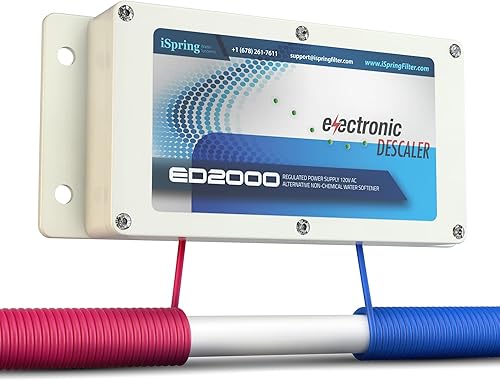
The iSpring ED2000 and EDV2 are electronic descalers. iSpring says both preserve water chemistry rather than removing calcium and magnesium.
These approaches address related but distinct concerns. If you want to understand how treatment differs from filtration, see our guide to water softeners vs water filters.
What does a water softener change?
A water softener reduces calcium and magnesium, the minerals that make water hard. That can help limit the scale and soap residue associated with hard water.
Ion-exchange softeners use resin to capture hardness minerals and release other ions in their place. The resin eventually needs regeneration, commonly using salt in a brine tank.
The Aquasure Harmony is an example of this type. It includes a resin tank, brine tank and programmable metered control head, which can be set for automatic flush intervals based on water quality and use.
Softened water has different mineral content from the incoming water. If your household wants minerals to remain in the water, a salt-free approach may better match that preference, though it won't remove hardness.
Is a softener the better choice for hard-water symptoms?
A softener is the more direct choice when your goal is to reduce hardness minerals throughout the home. That can matter if you want to address mineral scale as well as the feel of water and soap performance.
Start by measuring hardness rather than choosing a system based on a vague symptom. Our guide explains how to test water hardness at home, and our water softener sizing guide can help you connect a test result to capacity.
A softener needs suitable installation and ongoing care. Review the yearly water softener maintenance checklist before deciding whether a brine-based system fits your household.
What does a descaler do?
A descaler aims to reduce scale deposits without removing calcium and magnesium from water. That means hardness remains, even if the maker's scale-control claims match your home's conditions.
The ED2000 is an electronic descaler that iSpring says requires no plumbing modifications and no maintenance. iSpring describes it as designed for very hard water areas of 10–19 grains per gallon.
The EDV2 is also electronic and salt-free. iSpring says it preserves water chemistry, and its product information describes a noticeable improvement timeline of about 3 months.
Water conditions, plumbing and scale may affect the result, so a descaler doesn't promise the same outcome as removing hardness minerals.
Does a descaler make hard water soft?
No. A descaler doesn't remove hardness minerals, so the water remains hard by a standard hardness measurement.
This distinction matters if you expect softened water at the tap or want a hardness test to show lower mineral levels. A descaler is better understood as a scale-control option, not a substitute for ion exchange when mineral removal is the goal.
Which system fits your household?
Choose by the result you want: lower hardness, or scale control while keeping minerals in the water. Your water test and installation preferences can narrow the decision.
A softener is a stronger match if you want to reduce calcium and magnesium throughout the home. A descaler may fit if avoiding salt and plumbing changes matters more and you accept that hardness remains.
Water chemistry can also include issues beyond hardness, such as sediment or contaminants. A softener or descaler is not a universal filter, so see water softener and filter combos if you need to compare treatment roles.
| Your priority | More suitable option | What to expect |
|---|---|---|
| Reduce calcium and magnesium | Ion-exchange softener | Hardness minerals are removed from treated water |
| Keep minerals in the water | Electronic descaler | Hardness remains; the unit aims to manage scale |
| Avoid a brine tank | Electronic descaler | Salt-free operation |
| Get measurable hardness reduction | Ion-exchange softener | Confirm results with a hardness test |
What should you check before choosing?
Test your water and define the result you want before selecting equipment. Product claims can't replace a water test or confirm how a system will perform in your plumbing.
First, measure hardness at the point where you plan to treat water. If you use well water, check for other concerns separately; our guide to water softeners for iron in well water explains why iron needs its own consideration.
Next, decide whether you want mineral removal or a scale-focused method. If you select a softener, size it for your household and water use; if you select a descaler, review its stated water range and installation guidance.
Finally, account for maintenance and plumbing. A softener has a resin and brine system to care for, while iSpring describes the ED2000 and EDV2 as maintenance-free.
Is a descaler a replacement for a water softener?
A descaler isn't a direct replacement when you need hardness minerals removed. It serves a different purpose and leaves those minerals in the water.
If you mainly want to reduce scale deposits and prefer to keep the water's mineral content, a descaler may be worth considering. Set expectations around the maker's claims and allow time for any stated improvement period.
If you need lower hardness, choose an ion-exchange softener and confirm the result with a test. Pick the Aquasure Harmony when mineral reduction is your priority, or compare the best whole-house water softener systems to review other approaches.
Frequently asked questions
Does a descaler soften water?
A descaler does not soften water in the same way as an ion-exchange softener. It aims to reduce scale adhesion while leaving calcium and magnesium in the water, so a hardness test may still show hard water after installation.
Will a water softener stop scale?
An ion-exchange water softener removes hardness minerals that contribute to scale, so it can reduce scale formation in treated water. Results depend on proper sizing, setup and maintenance, and a softener doesn't remove every possible cause of deposits.
Do electronic descalers need salt?
The iSpring ED2000 and EDV2 are salt-free electronic descalers. They don't use a brine tank to remove hardness minerals, and iSpring says they leave water chemistry unchanged.
Which should I choose for hard water?
Choose a water softener if you want to reduce hardness minerals throughout the home. Consider a descaler if your main goal is to address scale without removing those minerals, and check the maker's guidance for your water conditions before choosing.
Can you use a descaler and water softener together?
They use different methods, so first identify the problem you want to solve and check both manufacturers' installation guidance. A softener reduces hardness minerals; a descaler aims to limit scale deposits while keeping those minerals in the water.


